hominidmedia: people: eugene v debs
media introduction:
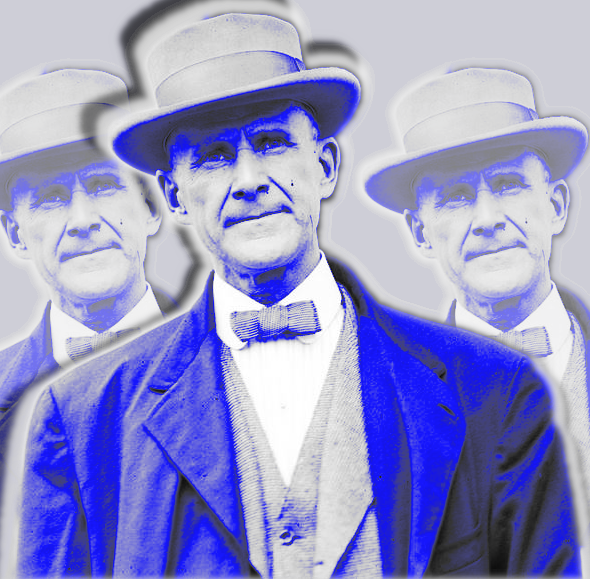
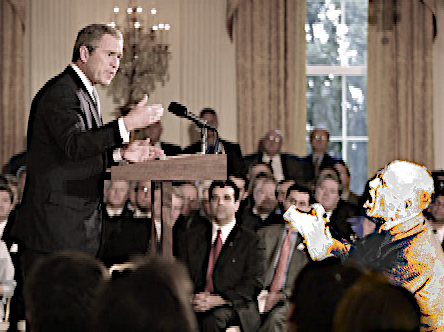

image credit: No provenance for this photo of Debs. Sometimes listed as "1912" and "American Socialist". This digital copy is from an online article by Stephen J. Taylor. "Eugene Debs, Jesus & The Woman In Scarlet" which was (at one time) hosted by Hoosier State Chronicles. [.html]
Yale Strom and Amy Madigan. American Socialist: The Life and Times of Eugene Victor Debs. Blackstream Films, 2017. [.html]. Young Turks interview with Strom hosted by [.youtube]. Here Debs is framed as the forgotten seminal figure who inspired both FDR and Bernie Sanders. This is probably intended as high praise by the "online progressive news show."
The other image of Debs, presumably from Canton 1918, was lifted from [The Militant] Volume 83 Number 18, 29 July 2019. Attributed to Tamiment Institute Library at New York University.
The image of George W. Bush is from the [archived White House Homepage] from the GWB administration. There is no credit to the photo captioned: "President Bush speaks to small business owners in the East Room of the White House"; dated 16 March 2001.
standard narrative:
Melvyn Dubofsky, Foster Rhea Dulles. Labor in America: A History Eighth Edition. Wheeling (IL): Harlan Davidson Inc., 2010. 148, 155-61, 163, 191. (First published, 1949).
Ray Ginger. The Bending Cross: A Biography of Eugene Victor Debs. Chicago: Haymarket Books, 2007 Haymarket Books. (First published, 1949).
Victor Devinz. "McCarthyism on the Charles: The Life and Times of Labour Historian Ray Ginger before and After His Dismissal from Harvard University." Left History 13.2 Fall/Winter 2008.
Ginger on Debs/Devinz on Ginger:
[load text]
Louis Hartz. The Liberal Tradition in America. New York: Harcourt, Brace & World, Inc., 1955. 244-247.
Hartz on Debs:
[load text]
Carl N. Degler. Out of Our Past: The Forces that Shaped Modern America. New York and Evanston: Harper Colophon, 1962. (First Published: 1959). 243, 270, 376.
Degler on Debs:
[load text]
Samuel Eliot Morison. The Oxford History of The American People. New York: Oxford University Press, 1965. (Second printing). 796, 814, 840, 874, 885, 920-1.
Oscar Handlin. America: A History. New York: Holt, Rinehart and Winston, 1968. 700, 701, 703, 707, 736, 738, 798, 1022.
James Weinstein. the Corporate ideal in the Liberal State. Boston: Beacon Press, 1968. 1-6, 116-120, 139-140, 180, 212-213.
Weinstein on Debs:
[load text]
Calvin D. Linton (ed). The Bicentennial Almanac: 200 Years of America. Nashville and New York: Thomas Nelson Inc., 1975. (Second Printing) 238, 240-242, 249, 266, 280, 296, 300, 303.
Linton on Debs:
[load text]
David Halberstam. The Powers That Be. Chicago: University of Illinois Press, 2000 (First published: 1975). 110.
Halbrstam on Debs:
[load text]
Keith Ian Polakoff, Norman Rosenberg, Grania Bolton, Ronald Story, Jordan Schwarz. Generations of Americans: A History of the United States. New York, New York: St. Martin's Press, Inc., 1976. 474, 551.
Howard Zinn. A Peoples History Of The United States. New York: Harper Perennial Modern Classics, 2005. (First Published: 1980). 278-9, 281, 330, 339-41, 347-8, 367-8.
Nick Salvatore. Eugene V. Debs: Citizen and Socialist. Urbana: University of Illinois Press, 2007 (First published, 1982).
Salvatore on Debs:
[load text]
Jack Barbash. "Debs, Eugene Victor" The World Book Encyclopedia. USA: World Book Inc., 1988.
Barbash on Debs:
[load text]
James West Davidson, William E. Gienapp, Christine Leigh Heyrman, Mark H. Lytle, Michael B. Stoff. Nation of Nations: A concise Narrative of the American Republic. New York: McGraw-Hill Inc., 1996. 487, 612, 617, 643, 648. (First printing, 1990).
John Mack Faragher, Mary Jo Buhle, Daniel Czitrom, Susan H. Armitage. Out of Many: A History of the American People. brief 4th ed. New Jersey: Pearson, 2004. 395, 421, 438, 442. (First Published: 1995).
Phillip Jenkins. A History of the United States. Second edition. UK: Palgrave Macmillan, 2003. 187-8. (First published, 1997.)
Paul Johnson. A History of the American People Great Britain: Weidenfeld & Nicolson, 1997. 568, 599-600, 634, 656, 669.
Johnson on Debs:
[load text]
James A. Henretta, David Brody, Susan Ware, Marilynn S. Johnson. America's History Volume 2: Since 1865 Boston: Bedford, 2000. 569-571, 641, 666, 708, 726.
Robert H. Zieger. America's Great War: World War I and the American Experience. Lanham, Boulder, New York and Oxford: Rowman & Littlefield Publishers, Inc., 2000. 77-84, 194-203.
Zieger on Debs:
[load text]
James Chace. 1912: Wilson, Roosevelt, Taft & Debs – The Election that Changed the Country. New York: Simon & Schuster, 2004. 66-90, 257-259.
Chace on Debs:
[load text]
Eric Foner. Give Me Liberty! An American History. WW. Norton: Second Seagull Ed., 2009. (First Published: 2005). 604, 652-3, 674, 696, 689, 737.
Thomas Bender. A Nation Among Nations: America's Place in World History New York: Hill and Wang, 2006. 248, 254-255.
Bender on Debs:
[load text]
James West Davidson and Christine Leigh Heyrman. US: A Narrative History. New York: McGraw-Hill, 2009. 463, 482, 487. Plus a doubled index (mis?)-print.
Susan-Mary Grant. A Concise History of the United States of America. Cambridge: Cambridge University Press, 2012. 246, 272, 279.
Grant on Debs:
[load text]
James West Davidson. A Little History of the United States. New Haven: Yale University Press, 2015. 220-221, 223.
Davidson on Debs:
[load text]
Martinek, Jason. "The Diva and the Socialist: Sara Bernhardt, Camille, and Eugene Debs's Crusade to Save the Fallen Woman." Indiana Magazine of History, 115 (June 2019).
Martinek describes Debs' masculine paternalistic protection of women as it was inspired by a play Debs saw in the 1880s. Based on a letter he sent to his brother from prison.
primary sources:
Eugene V. Debs archive hosted by [marxists.org]. Debs is prolific and there are hundreds of hosted documents. A sampling:
on "Temperance" (1879):
[load text]
Boycotting (1886), The Chicago Anarchists, Pullman (1887) The Great Strike and The Record of the CB&Q Strike (1888). The "Great Strike" was the national railroad strike that would be the model for Pullman in 1894. The idea of a national strike resulted in a federal response.
Strike (1890), Labor Omnia Vincit, Letter from Woodstock Jail and Speech in Atlanta (1895). This is the period leading up to Pullman. Targeting the federal rail lines led to strike breaking (a corporate-federal alliance) protecting interstate commerce.
IWW (1905). The American Socialist dialectic of the period was split between direct (immediate) and indirect (political) action. This is before socialist politicians and industrial unionists were outlawed by the Espionage and Sedition acts of the WWI era. Debs runs as a radical--the best of both worlds--and (perhaps) one catalyst for the federal crackdown.
Presidential Candidate (1904), (1908), (1912), (1920). Debs was a reluctant candidate (according to Salvatore) but a skilled orator and tireless campaigner.
Canton (1918). This is the pacifist, non-interventionist, internationalist speech that landed Debs in Federal prison, charged with Sedition. He gave the speech on June 16 and was arrested on June 30. This speech is the focus of much of the Debs coverage by secondary sources.
Tim Davenport and David Walters. [the debs project].
media introduction:
image credit: No provenance for this photo of Debs. Sometimes listed as "1912" and "American Socialist". This digital copy is from an online article by Stephen J. Taylor. "Eugene Debs, Jesus & The Woman In Scarlet" which was (at one time) hosted by Hoosier State Chronicles. [.html]
Yale Strom and Amy Madigan. American Socialist: The Life and Times of Eugene Victor Debs. Blackstream Films, 2017. [.html]. Young Turks interview with Strom hosted by [.youtube]. Here Debs is framed as the forgotten seminal figure who inspired both FDR and Bernie Sanders. This is probably intended as high praise by the "online progressive news show."
The other image of Debs, presumably from Canton 1918, was lifted from [The Militant] Volume 83 Number 18, 29 July 2019. Attributed to Tamiment Institute Library at New York University.
The image of George W. Bush is from the [archived White House Homepage] from the GWB administration. There is no credit to the photo captioned: "President Bush speaks to small business owners in the East Room of the White House"; dated 16 March 2001.
standard narrative:
Melvyn Dubofsky, Foster Rhea Dulles. Labor in America: A History Eighth Edition. Wheeling (IL): Harlan Davidson Inc., 2010. 148, 155-61, 163, 191. (First published, 1949).
Ray Ginger. The Bending Cross: A Biography of Eugene Victor Debs. Chicago: Haymarket Books, 2007 Haymarket Books. (First published, 1949).
Victor Devinz. "McCarthyism on the Charles: The Life and Times of Labour Historian Ray Ginger before and After His Dismissal from Harvard University." Left History 13.2 Fall/Winter 2008.
Ginger on Debs/Devinz on Ginger:
[load text]
Louis Hartz. The Liberal Tradition in America. New York: Harcourt, Brace & World, Inc., 1955. 244-247.
Hartz on Debs:
[load text]
Carl N. Degler. Out of Our Past: The Forces that Shaped Modern America. New York and Evanston: Harper Colophon, 1962. (First Published: 1959). 243, 270, 376.
Degler on Debs:
[load text]
Samuel Eliot Morison. The Oxford History of The American People. New York: Oxford University Press, 1965. (Second printing). 796, 814, 840, 874, 885, 920-1.
Oscar Handlin. America: A History. New York: Holt, Rinehart and Winston, 1968. 700, 701, 703, 707, 736, 738, 798, 1022.
James Weinstein. the Corporate ideal in the Liberal State. Boston: Beacon Press, 1968. 1-6, 116-120, 139-140, 180, 212-213.
Weinstein on Debs:
[load text]
Calvin D. Linton (ed). The Bicentennial Almanac: 200 Years of America. Nashville and New York: Thomas Nelson Inc., 1975. (Second Printing) 238, 240-242, 249, 266, 280, 296, 300, 303.
Linton on Debs:
[load text]
David Halberstam. The Powers That Be. Chicago: University of Illinois Press, 2000 (First published: 1975). 110.
Halbrstam on Debs:
[load text]
Keith Ian Polakoff, Norman Rosenberg, Grania Bolton, Ronald Story, Jordan Schwarz. Generations of Americans: A History of the United States. New York, New York: St. Martin's Press, Inc., 1976. 474, 551.
Howard Zinn. A Peoples History Of The United States. New York: Harper Perennial Modern Classics, 2005. (First Published: 1980). 278-9, 281, 330, 339-41, 347-8, 367-8.
Nick Salvatore. Eugene V. Debs: Citizen and Socialist. Urbana: University of Illinois Press, 2007 (First published, 1982).
Salvatore on Debs:
[load text]
Jack Barbash. "Debs, Eugene Victor" The World Book Encyclopedia. USA: World Book Inc., 1988.
Barbash on Debs:
[load text]
James West Davidson, William E. Gienapp, Christine Leigh Heyrman, Mark H. Lytle, Michael B. Stoff. Nation of Nations: A concise Narrative of the American Republic. New York: McGraw-Hill Inc., 1996. 487, 612, 617, 643, 648. (First printing, 1990).
John Mack Faragher, Mary Jo Buhle, Daniel Czitrom, Susan H. Armitage. Out of Many: A History of the American People. brief 4th ed. New Jersey: Pearson, 2004. 395, 421, 438, 442. (First Published: 1995).
Phillip Jenkins. A History of the United States. Second edition. UK: Palgrave Macmillan, 2003. 187-8. (First published, 1997.)
Paul Johnson. A History of the American People Great Britain: Weidenfeld & Nicolson, 1997. 568, 599-600, 634, 656, 669.
Johnson on Debs:
[load text]
James A. Henretta, David Brody, Susan Ware, Marilynn S. Johnson. America's History Volume 2: Since 1865 Boston: Bedford, 2000. 569-571, 641, 666, 708, 726.
Robert H. Zieger. America's Great War: World War I and the American Experience. Lanham, Boulder, New York and Oxford: Rowman & Littlefield Publishers, Inc., 2000. 77-84, 194-203.
Zieger on Debs:
[load text]
James Chace. 1912: Wilson, Roosevelt, Taft & Debs – The Election that Changed the Country. New York: Simon & Schuster, 2004. 66-90, 257-259.
Chace on Debs:
[load text]
Eric Foner. Give Me Liberty! An American History. WW. Norton: Second Seagull Ed., 2009. (First Published: 2005). 604, 652-3, 674, 696, 689, 737.
Thomas Bender. A Nation Among Nations: America's Place in World History New York: Hill and Wang, 2006. 248, 254-255.
Bender on Debs:
[load text]
James West Davidson and Christine Leigh Heyrman. US: A Narrative History. New York: McGraw-Hill, 2009. 463, 482, 487. Plus a doubled index (mis?)-print.
Susan-Mary Grant. A Concise History of the United States of America. Cambridge: Cambridge University Press, 2012. 246, 272, 279.
Grant on Debs:
[load text]
James West Davidson. A Little History of the United States. New Haven: Yale University Press, 2015. 220-221, 223.
Davidson on Debs:
[load text]
Martinek, Jason. "The Diva and the Socialist: Sara Bernhardt, Camille, and Eugene Debs's Crusade to Save the Fallen Woman." Indiana Magazine of History, 115 (June 2019).
Martinek describes Debs' masculine paternalistic protection of women as it was inspired by a play Debs saw in the 1880s. Based on a letter he sent to his brother from prison.
primary sources:
Eugene V. Debs archive hosted by [marxists.org]. Debs is prolific and there are hundreds of hosted documents. A sampling:
on "Temperance" (1879):
[load text]
Boycotting (1886), The Chicago Anarchists, Pullman (1887) The Great Strike and The Record of the CB&Q Strike (1888). The "Great Strike" was the national railroad strike that would be the model for Pullman in 1894. The idea of a national strike resulted in a federal response.
Strike (1890), Labor Omnia Vincit, Letter from Woodstock Jail and Speech in Atlanta (1895). This is the period leading up to Pullman. Targeting the federal rail lines led to strike breaking (a corporate-federal alliance) protecting interstate commerce.
IWW (1905). The American Socialist dialectic of the period was split between direct (immediate) and indirect (political) action. This is before socialist politicians and industrial unionists were outlawed by the Espionage and Sedition acts of the WWI era. Debs runs as a radical--the best of both worlds--and (perhaps) one catalyst for the federal crackdown.
Presidential Candidate (1904), (1908), (1912), (1920). Debs was a reluctant candidate (according to Salvatore) but a skilled orator and tireless campaigner.
Canton (1918). This is the pacifist, non-interventionist, internationalist speech that landed Debs in Federal prison, charged with Sedition. He gave the speech on June 16 and was arrested on June 30. This speech is the focus of much of the Debs coverage by secondary sources.
Tim Davenport and David Walters. [the debs project].