hominidmedia: people: lucy parsons
media introduction:
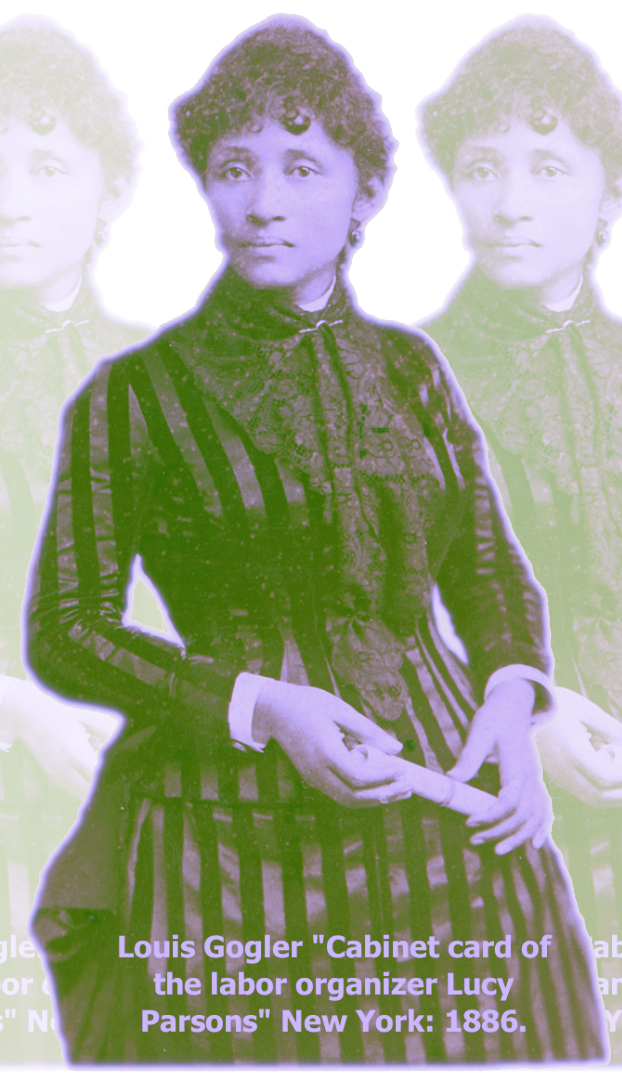
image credit: Louis Gogler. "Photo of Lucy Parsons." New York, 1886. [commons.wikimedia.org].
Richard Schneirov. "The Haymarket Bomb in Historical Context: Workers' Organization in Chicago" Northern Illinois University Library Digital Initiatives 2008. [archive.org].
Schneirov discusses the Haymarket bombing--inspired by anarchists like Lucy Parsons--and dynamite.
standard narrative:
Melvyn Dubofsky, Foster Rhea Dulles. Labor in America: A History Eighth Edition. Wheeling (IL): Harlan Davidson Inc., 2010. 112. (First published, 1949).
In reference to Albert, "Organized labor was in no way associated with the Haymarket Square bombing and had at once denied any sympathy whatsoever for the accused anarchists."
Howard Zinn. A Peoples History Of The United States. New York: Harper Perennial Modern Classics, 2005. (First Published: 1980). 249.
Lucy appears nameless in the Zinn narrative as a "brown-skinned woman of Spanish and Indian blood..." who was married to "fiery" Albert.
Carolyn Ashbaugh. Lucy Parsons: An American Revolutionary. Chicago: Haymarket Books, 2013. (First published 1976).
Ashbaugh describes Parsons primary anti-capitalist focus. All other social constructs of oppression stem from her socialist critique of class. Ashbaugh describes Parson's anarchism as "organiz[ing] the working class for social change."
Eric Foner. Give Me Liberty! An American History. WW. Norton: Second Seagull Ed., 2009. 595. (First Published: 2005).
Jacqueline Jones. Goddess of Anarchy. New York: Basic Books, 2017.
To Jones, "Ashbaugh outlined in great detail the trajectory of Parsons's public life, but provided a largely uncritical perspective of her activism." Jones' places Parsons' private life alongside the public. Parsons played with nationalism, race, gender, domesticity, political economy and radicalism with a "certain ruthlessness" which alienated her allies and ultimately hindered the movement. To Jones, Parsons "career amounts to an indictment of sorts of the radical labor leaders who fell back on threats of violence, misread the fears and disdained the deeply held values of many laboring men and women, and alienated key constituencies as unworthy and irrelevant to the fight for justice..." (Jones xiv-xv)
Nicole Greer Goulda. "Learn the Use of Explosives..." review of Jacqueline Jones from The Journal of the Gilded Age and Progressive Era (Vol. 18, Issue 2) 2019. 242-243.
primary sources:
Lucy Parsons. "A Word to Tramps" The Alarm [Chicago], vol. 1, no. 1 (Oct. 4, 1884), pg. 1. [marxists.org].
This is Parson's classic appeal to tramps "Learn the use of explosives!" In it she also makes a radical systemic argument against Capitalism that relied on resentment to over production rather than focusing on an individual shop boss.
media introduction:
image credit: Louis Gogler. "Photo of Lucy Parsons." New York, 1886. [commons.wikimedia.org].
Richard Schneirov. "The Haymarket Bomb in Historical Context: Workers' Organization in Chicago" Northern Illinois University Library Digital Initiatives 2008. [archive.org].
Schneirov discusses the Haymarket bombing--inspired by anarchists like Lucy Parsons--and dynamite.
standard narrative:
Melvyn Dubofsky, Foster Rhea Dulles. Labor in America: A History Eighth Edition. Wheeling (IL): Harlan Davidson Inc., 2010. 112. (First published, 1949).
In reference to Albert, "Organized labor was in no way associated with the Haymarket Square bombing and had at once denied any sympathy whatsoever for the accused anarchists."
Howard Zinn. A Peoples History Of The United States. New York: Harper Perennial Modern Classics, 2005. (First Published: 1980). 249.
Lucy appears nameless in the Zinn narrative as a "brown-skinned woman of Spanish and Indian blood..." who was married to "fiery" Albert.
Carolyn Ashbaugh. Lucy Parsons: An American Revolutionary. Chicago: Haymarket Books, 2013. (First published 1976).
Ashbaugh describes Parsons primary anti-capitalist focus. All other social constructs of oppression stem from her socialist critique of class. Ashbaugh describes Parson's anarchism as "organiz[ing] the working class for social change."
Eric Foner. Give Me Liberty! An American History. WW. Norton: Second Seagull Ed., 2009. 595. (First Published: 2005).
Jacqueline Jones. Goddess of Anarchy. New York: Basic Books, 2017.
To Jones, "Ashbaugh outlined in great detail the trajectory of Parsons's public life, but provided a largely uncritical perspective of her activism." Jones' places Parsons' private life alongside the public. Parsons played with nationalism, race, gender, domesticity, political economy and radicalism with a "certain ruthlessness" which alienated her allies and ultimately hindered the movement. To Jones, Parsons "career amounts to an indictment of sorts of the radical labor leaders who fell back on threats of violence, misread the fears and disdained the deeply held values of many laboring men and women, and alienated key constituencies as unworthy and irrelevant to the fight for justice..." (Jones xiv-xv)
Nicole Greer Goulda. "Learn the Use of Explosives..." review of Jacqueline Jones from The Journal of the Gilded Age and Progressive Era (Vol. 18, Issue 2) 2019. 242-243.
primary sources:
Lucy Parsons. "A Word to Tramps" The Alarm [Chicago], vol. 1, no. 1 (Oct. 4, 1884), pg. 1. [marxists.org].
This is Parson's classic appeal to tramps "Learn the use of explosives!" In it she also makes a radical systemic argument against Capitalism that relied on resentment to over production rather than focusing on an individual shop boss.