John Brown
photo credit:
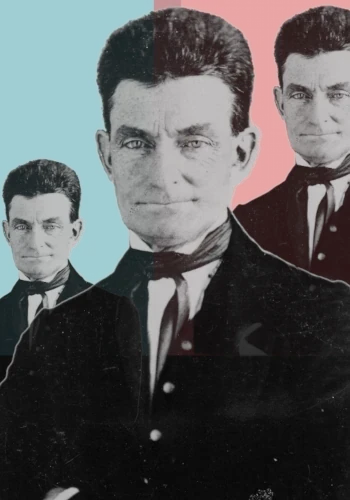
"John Brown (before acquisition of beard which typifies him as the stormy prophet of emancipation)" copy of dagurreotype, circa 1850. National Archives Identifier: 532587 [archives.gov]Public Domain-unrestricted: Photographs and Other Collections > Records of the U.S. Marine Corps (Record Group 127) > General Photograph File > War and Conflict Number 114 > Access: Unrestricted; Use: Unrestricted
hominidmedia:
other:
In his last speech Brown explains his abolitionist conspiracy and method. In Missouri he had been successful freeing and transporting slaves north to Canada "without the snapping of a gun." Attacking the armory at Harper's Ferry was part of this peaceful abolitionist goal. John Brown's funding--personified by the Secret Six--and later historians like Stephen Oates frame Harper's Ferry as a revolutionary catalyst that led to the Civil War. Brown, in his last speech, disagrees. He did not intend to "incite slaves to rebellion or make insurrection." He also didn't want to kill, destroy property or commit "treason." Brown appeals to religion, not politics. He doesn't know why God compelled him to act on behalf of the enslaved "despised poor." He accepts the death sentence without admitting to God any moral failing. It is hard to understand why Brown thought God--and his agents on earth like FB Sandborn--envisioned a peaceful abolitionist raid on a federal arsenal to play out.
Sandborn published Brown's letters with limited biographical narrative in 1885. He frames Brown among his contemporaries: Victor Hugo, Frederick Douglass, Ralph Waldo Emerson and Henry David Thoreau. Sandborn's take on Brown's legacy is a Cromwellian "historic character [with a] predestined relation to the political crisis of his time." Sandobrn's revolutionary hero is very different than Brown's unintentional insurrectionary. The Sandborn version is probably closer to the actual Harper's Ferry raider.
Debs, who was named after Hugo, published a hagiography of Brown in 1907. Like Sandborn, Debs framed Brown with Hugo and Thoreau. Debs links Brown's "martyrdom" and the end of "chattel slavery." He then calls for modern movement against "wage-slavery" inspired by Brown. Sandborn's abolitionism and Debs socialism can adopt Brown for evolving purposes long after John Brown's body is mouldering in the grave.
Du Bois published a biography of Brown in 1909. He cites Redpath, Sandborn, Hinton, Connelly and Redpath as authors who he followed with this Colored Person's take from the NAACP's American Crisis biography series. To do that he emphasizes the the Frederick Douglass "John Brown" lectures, Osborne Anderson's A Voice from Harper's Ferry and Alexander Boteler's "Recollections...". Du Bois synthesis produced the same heroic martyr narrative as Sandborn and Debs. When Brown is used by, post facto, by social movements like the Niagara, socialist or communists--the hero story is reinforced. Du Bois version of the great man theory is that Harper's Ferry "did more to shake the foundations of slavery than any single thing that ever happened in America." Brown proves that revolutionary actions can cause social change in America. Du Bois and Oates are fascinated by Brown's concept of "purging the land."
Filler's book is about political abolitionism which is opposed to Brown's revolutionary vision. Brown appears in this narrative as a link between media abolitionists and political reformers. These include Garrison, Douglass and Eli Thayer. One theme is Brown's friendly formality with black people. Dana thought it was an act when he used prefixes and surnames toward them. Brown called Harriet Tubman General and commented on her masculinity. Garrison and Douglass continued to use John Brown for abolitionist political causes. Filler and Thayer believe Brown should not be used for this political purpose because he was a drifter, failed businessman and homesteader--not an abolitionist. His actions were disjointed, destructive and ineffective. He capitalized on freed slaves and was not a "responsible" or "scrupulous" as an abolitionist. His self interest overshadowed his social impact and, therefore, he shouldn't be martyred. Lawless reform, to Filler, is unjustified. Filler draws a line between the moral and social revolution of abolitionism and Brown's personification of "revolution itself." Brown's authenticity is at question because he "was not a member of any abolitionist group, but he had patronized them all."
Oates biography of Brown avoids the Redpath heroic version and Malin criminal version of Brow. He is also critical of sanity as an analytical tool. Oates' focus is in Calvinism and "nonconformist abolitionism." By describing Brown as a man of his times, Oates deconstructs the political value of Brown's legend to revolutionaries, reformists and reactionaries. The politicization of Brown was happening by Sandborn before Harper's Ferry. It was amplified afterwards by Garrison and other northerners who might have been skeptical of the raid's political power. Oates describes the transformative political power which develops after Harper's Ferry. Brown's abolitionist value post mortem is not, to Oates, constrained by his heterodox ideologies.
The National Parks Service published a sixty page book about Harper's Ferry for the Historical Park on the site of John Brown's raid. The sources include Sandborn, Filler and Oates. The early biographical narrative of a a pious man, a father, a drifter and a failure in business the same as the earlier biographies. Bleeding Kansas provided recruits for the raid in Virginia. Brown told these men that "he was organizing a company of men to resist pro-slavery aggression." When looking for funding he framed it as a "guerrilla" act that would lead to a "slave uprising." The armory was to supplement the stockpile of weapons that Brown had amassed at a nearby farm and arm the revolting black people. The NPS narrative did cite Douglass directly on the "steel-trap" that awaited the Raiders. Thoreau's gallows "like the cross" is attributed to "radical" northerners. Conservative northern sentiment "condemned the raid as the work of a madman.
Finkleman is evidence of the shifting acceptability of political language as the state, labor and socialist movements try to define the Brown narrative in the twenty first century. In the print article from Prologue Finkleman's article was titled "John Brown: America's First Terrorist." The article which appears on the National Archives website is titled "Remembering John Brown." Finkleman still connects terrorism, heterodox abolitionism and revolutionary ideologies. The provocative title probably didn't need Finkleman's consent to be censored.