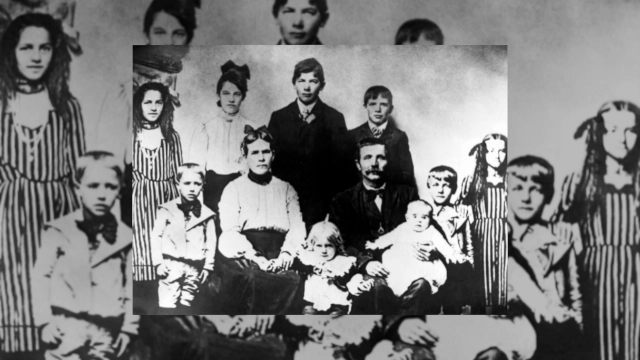
 Family Photo (c. 1901-2)
The evening of 6 October 1904 Josef Foral led a wagon from his home farm in Spruce (WI) taking grist to the mill in Lena. He fell, hit his head and died in town a few hours later. He left Maggie Foral and the nine kids on the farm. This family narrative comes from prolific Oconto County (WI) genealogist Bill Fonferek. There are documents from that period—Josef’s death certificate (27 October 1904), Wisconsin State Census (1 June 1905), US Federal Census (5 May 1910) and Joe Jr.’s marriage certificate (15 June 1912)—that further define this event and its aftermath.
Josef and Marguerite were immigrants from modern Czechia. He was born in Brno in 18 August 1862 and Christened the next day. He departed from Havre on the SS France on 13 August 1881 and arrived in New York on August 25. Josef was naturalized Joseph Foral in Oconto on 1 April 1884.
Marguerite was born in April 1868 in Klatovy. She immigrated to Leopolis (Shawano County) in 1881 with her parents. Joseph Stefl and Mary Katherine Kadletz are interred at St. Mary’s Cemetery in Leopolis. Marguerite lived in Spruce, usually called Maggie or Margaret, until 1944.
Joseph and Maggie married on 25 July 1883 before either was a citizen. Maggie naturalized in 1909 five years after her husband died. Joseph John Foral and Margaret Stefl Foral are buried in Pine Hill Cemetery in Spruce. This is referenced as the historic "Bohemian Burial Grounds" by Fonferek.
After Joseph died, his wife's name varied on official documents. This includes an Anglicization from Marguerite to diminutive "Maggie" (‘04, ‘05, ‘12) to "Margaret" on her headstone in '44. In '12 her surname is "Steffel" on Joe Jr.'s marriage certificate. This spelling change might be influenced by the Steffel's in Spruce who lived on an adjacent homestead. Maggie "Steffel" was only recorded as such in '12.
The 1912 "Steffel" is an unpredictable name that can be explained by something like geography, tradition, Anglicization or misspelling. But, two other unpredictable names appear during this period one each in 1905 and '10.
Joseph Foral, dead for a half a year, appears on the 1905 state census as a 42 year old Austrian male, head of household. He is married to a 38 year old Austrian woman named Maggie with no previous record. In 1910, the head of household is a 43 year old Austrian-Bohemian widow named Josephine Foral.
The reconciliation of the phantom Joseph from 1905 might be about property rights to the farm. The recording of Maggie's citizen husband on the state census in 1905 did give her five years to get her papers in order before the Federal census in 1910. Property rights might be one reason Maggie naturalized in 1909. The rights of non-citizen women in rural Wisconsin might be more limited by law and custom.
"Josephine Foral" from 1910 doesn’t concern property rights. One possible resolution to this is Foral family cultural linguistics. There could be conventions of historic Slavic, German or Latin periods that influence Maggie’s name that come from the family's "Bohemian" tradition. Maggie's cultural history comes from a muddled Eastern Europe imprinted on a inconsistently defined rural frontier.
To compound the muddle, the two were from different parts of Czechia. Joseph was Moravian and Maggie was Bohemian. The Foral surname is common in east Czechia. There are stores and professionals in Brno and Babice with this last name. Fonferek’s version of the Foral family tree includes surnames Suchý, Mikšík and Savčina. These are also surnames from Josef's Moravia.
The town where most of Josef’s family are born is Babice in today’s Uherské Hradiště District of the Zlín Region. This is near Brno, Josef's recorded birthplace. Geographically this is the South Moravian region of eastern Czechia. Brno has historically been a large enough urban place to have different cultural traditions (and possibly naming conventions).
Only one of Brno’s influences is Prague, the major city of Bohemian culture. Brno is one of three traditional Moravian cities east of Bohemia. Other conceptions of the state have also historically included Slovakia (Bratislava) to the east of the Moravia. Within this Czech-Slovak geography, Brno is parts Bohemian and Slovak but it is historically Moravian.
Moravia, the region, drains into Eastern Europe. One thousand years ago, Moravia included three settlements: Olomouc, Brno and Znojmo. The northern city is Olomouc on the Morava River. Brno is in the middle located where the Svitava flows into the Svratka River about 64 km south west of Olomouc. Svratka is a tributary of the Dyje (aka Thaya) River. The Dyje is a tributary of the Morava. Thaya River begins in Austria at the confluence of the German and Moravian branches of the river. About 55km south west of Brno is Znojmo. The Morava is a tributary of the Danube River that connects west of Bratislava. The Morava begins near Poland at the mountain Králický Sněžník. That implies a Polish cultural tributary to the region which is different than the Germanic Prague.
Josef was Christened in Brno. There was a Catholic Church in Spruce when Joseph lived there. The local naming conventions were probably influenced by this Latin tradition. Oconto County was settled predominantly by Catholics: first French and then Czechs, Germans and Poles. These regions also had historic regional reformed Christian traditions: Hussite, Lutheran, Anglican and Huguenot. Regionally the historic religious map of immigrants to Oconto county also includes Islam from Türkiye, Judaism from Poland and Orthodox Christianity from Ukraine.
Josef the Moravian and Marguerite the Bohemian were of the Latin tradition but they were born in an Eastern European region that was historically contested theological space. This influenced the names of their kids. Anna (Sainted mother of Mary) and Emma (of Stiepel) are traditionally Catholic. Anton born in Oconto had an uncle Antonin born in Moravia who only lived four months. This is a common Czech version of the Latin name Antonius. Joseph Junior is an Anglophone signification of family lineage. Mamie is a diminutive version of this. Both George and Albert could have contemporaneous Victorian significance. Edmond might be named after St. Edmund who was a 9th century Anglo-Saxon hero killed by the Norse. The other first generation Foral was named Willon. This is not a common English version with obvious historic significance.
Add to these Catholic and English traditions a third, Slavic, naming convention. This includes patronymic derivation, which is a version of the Anglo suffix seen in Joe "Junior." The Slavs describe someone as the child of their father. The result of this convention is a girl born to Marguerite and Josef named Josefina or "daughter of Josef." Mamie, the daughter of Marguerite, is in this type; but her name signifies matrilineage. The oldest Foral son was named George, a British sounding name without obvious kinship significance. The next got the Anglo version of patronymic derivation and is named "Junior."
This isn’t the mechanism that caused Maggie’s name change in 1910. Marguerite was from the Bohemian side of Czechia. This might include different German naming conventions than the West Slavs of Moravia. The German diminutive convention seems to generally describe what is happening in the '10 census. Two German suffixes that fit this diminutive purpose are observed in examples—little woman: (Frau)-lein and little rabbit: (Hase)-chen. When Marguerite answers to Josephine she is literally "little" Josef. This isn’t a social rule about the hierarchy of parentage or disciple-ship. Instead this appears to be an affectionate way for Maggie to refer to her dead husband Joseph (or a book-keeping tactic or an ill-informed census taker).
The satisfying part of the German diminutive convention is that it fits with Marguerite’s personal style of diminution. In ‘04, ‘05 and ‘12 she was called "Maggie" or little Marguerite. She discarded this by the 1940s for "Margaret" which is the permanent name on her headstone.
It is possible that in 1910 she tried on a hybrid German-Slavic: little Josef or "Josephine" that referenced her husband after his unexpected death. That was not a long term fit. By Junior’s wedding in 1912 she was called to Maggie "Steffel" Foral.
There are more maudlin, legal and patriotic ways to interpret this nominal change and resolve the historical inconsistency. The satisfying way to understand Maggie’s years as Josephine is as a fashion influenced by her cultural heritage in memory of her husband. We all have the agency to interpret our individual historical culture within the modern social zeitgeist and invent traditions that address modern conditions.
This can be as simple a trying on a new name.
image credit:
Bill Fonferek. "Foral Family Photo" from Descendants of Jakub Foral; via rootsweb: (14 December 2015); photo c.1901-2 because of baby Edmond (b. 16 August 1901) in Joseph's lap.
wrb. "authority" hominidmedia., rev. 2 May 2024.