Frank P. Zeidler was the last of Milwaukee's Sewer Socialist mayors. The list includes Emil Seidel (1910-12), Daniel Hoan (1916-40) and Zeidler (1948-60). Milwaukee's labor left is different than Madison's liberal progressives. This is also different than conservationists on Superior, in the Northwoods and the Driftless. These are three political traditions within Wisconsin's traditional left coalition.
Of the Milwaukee socialists Victor Berger was the most visible early leader. He was elected to the US house of representatives three times in 1911, '19 and '23. The house refused to seat him in the middle term under Section 5 of the constitution. In a public television appearance in 1987 Zeidler said, "...opposition to U.S. involvement in WWI and the Red Scare at the time created problems for Berger..."
In addition to fostering the Milwaukee Socialists, Berger also introduced Eugene V. Debs to Das Kapital as he sat in prison following the Pullman Strike.
The problem that Zeidler described from 1919 was a fear of both Communism and Germans. Berger and Debs shared the former stigma. Both socialists, the Austrian Berger and Hoosier Debs, were excluded from society because of their political beliefs. In Berger's case this was also part of American chauvinism.
The link between Debs and the sewer socialists also includes Seidel who was VP on Debs' presidential ticket in 1912. These Socialist tickets are historically opposed by Progressive parties nationally (like T.Roosevelt) and in the state (like B.La Follette).
Hoan and Zeidler are evidence of the continuity of the infrastructure building brand of midwestern American socialism. This exists before and after Debs and is distinct from the other leftists in the state. This is a relevant political regime with political power from the Gilded Age well past WWII.
The popular and historic relevance of the sewer socialists continues today as Milwaukee's iconic Hoan Bridge constructed between 1970-7. The Zeidler interview from 1987 is proof of a stable theoretical heritage of Sewer Socialism--typified by building and maintaining public infrastructure--over more than a century.
The continuity of this long history is dramatically different than the sharply punctuated histories of labor actions, repressive laws, agency raids or political machinations that usually describe the decline of Labor power from the Gilded Age through the Cold War. Even with this continuity, the precariousness of Berger's seat in 1919 shows there are limits to Social Democracy in America for actual Socialists.
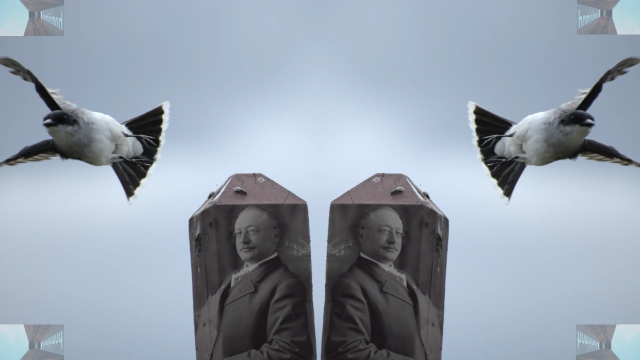
image credit: Victor Berger Harris & Ewing 1905. hosted by Washington D.C.: Library of Congress; Prints & Photographs Online Catalog; reproduction number: LC-DIG-hec-16979 (digital file from original negative). PD-before 1929.
source credit: Frank P. Zeidler. "Constitutional Minutes" (series); "Wis. Committee for the Bicentennial of the Constitution" (client) Madison, WI: WHA-TV. spot: #103. hosted by: American Archive of Public Broadcasting.