hist_img:
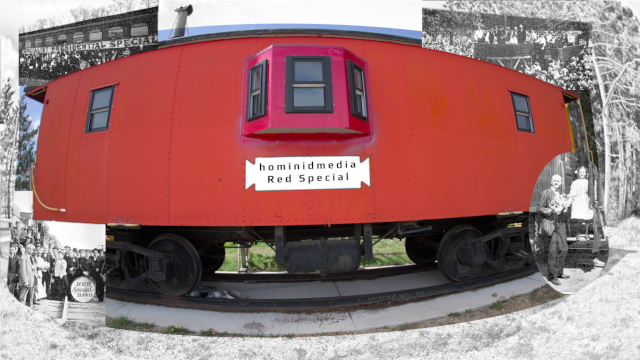
Debs' Red Special
The caboose in the picture is from the "South Shore Railroad" and located in Coloma (WI). The car sits miles away from railroad's service area of Chicagoland: downtown to northwest Indiana. This tiny lost box would be overshadowed on any train yard or museum in the country but in the town park in rural Coloma--tucked between the baseball field, tennis courts and a VFW Howitzer--this is a towering red hunk, rusted to a disconnected piece of track scarcely longer then the car itself. Here it is prestigious and remarkable.
The 1908 Red Special was a national train tour by EV Debs and his allies campaigning for various elections, including Debs for president as a Socialist Party of America (SPA) candidate. Like the red caboose in Coloma, the Red Special began in Chicagoland and is remembered in the places it stopped.
The superimposed photos are from a pamphlet by Charles Lapworth titled "The Tour of the Red Special" which chronicled the last months of EV Debs' second (of four) presidential campaign spent on the Red Special train. Lapworth--a British journalist, internationalist and industrial union syndicalist--created a narrative of the Red Special that is frantic and of Debs' political supporters that is fervent.
The 1908 election was a middle point of the nation's Progressive Era taste of democratic socialism which peaked during the 1912 election. Socialist electoral momentum didn't survive federal repression during WWI, the Palmer Raids and Red Scare--after which the remaining American left found structural obstacles to democratic-socialism. The campaign of 1908 was exhausting for Debs, his brother Theodore, campaign director Harry Parker, Debs' friends and the fellow travelers that featured along the way. This cast was a broader cross section of the American left than just SPA members and trade unionists (including Populists, Non Partisans, Georgists, Episcopalians, Congregationalists, essayists and Suffragists) with two conspicuous absences--Lapham didn't mention any anarchists or La Follettes (more on that in the third leg). Whistle stop tours are not new to American politics but the Red Special was an audacious (if electorally insignificant[1]) campaign by the emerging SPA in it's second presidential election.
There were three legs of the Red Special--west, east and north. The first, western leg, began in Lemont Park Chicago with a "picnic crowd" and featured speeches by Debs and Illinois SPA gubernatorial candidate James H. Brower. The train was greeted by crowds in Davenport, Des Moines, Kansas City, Leavenworth, and St. Joe--the socialists on board were ready to "rip the old parties up the back and front." The entire trip was financially precarious and these first few stops of the western leg funded the rest of the trip through ticket sales. The early stops also demonstrated interest in a national tour to Debs' hesitant partisans in the National office. (Lapworth 403)
The Red Special entered the mountains and stopped in Denver; then the "sad experience" of destitute Leadville miners; in Glenwood Springs they received "fruit and flowers"; spoke at Ogden and arrived in Salt Lake "the city of Mormons..." for a "Labor Day demonstration" and meeting. Twelve hours later they were in Las Vegas for two days of rain and meetings. Then to San Bernardino where there was a parade. Next, 14,000 people in San Diego saw Debs, playwright (and screenwriter) H. Austin Adams[2] and International Socialist Review editor Algie Martin Simons speak. Then the Red Special visited LA and San Francisco. At UC-Berkeley Debs proposed abolishing the constitution. (Lapworth 406)
Lapworth captured a couple of notable anecdotes from the trip west. One was a man wearing a gun who swore to retaliate against "the man who hurts Gene" and another was an old man in Grand Junction who professed his long time devotion to Debs as they embraced. Simmons de-boarded in San Francisco and Harry McKee [?] took his spot. The Red Special went north into lumber country: Portland and Seattle. Towns closed and citizens met the train at the depot to hear the speeches. Everett was "like a religious revival." (Lapworth 407-9)
They turned east into "mining districts that have been making history during recent years" like Wardner, Wallace, Mullan and Missoula (where a large crowd waited at the depot for a delayed Red Special with a massive red flag), Butte (site of a recent strike), Sheridan and Billings. In the town of Lead they had "one of the finest meetings of the campaign" where South Dakota Populist Freeman Knowles spoke. Minneapolis Non Partisan League leader Beecher Moore was featured in Minnesota. They stopped in St. Paul, Duluth, Hancock, Green Bay and spent "a full day at Manitowoc" before heading ending back to Chicago. The labor strong hold of Milwaukee would be visited in the third trip. Lapworth states that planks of Debs' Western stump speech included labor rights, ending child slavery, women's "emancipation" and the "evils of prostitution." (Lapworth 409-11)
The Red Special rested in Chicago for "two or three hours" before starting east. The first stop was Indianapolis, followed by South Bend, Battle Creek, Albion, Jackson and then Detroit ("the biggest scab town in the States"). America's first socialist mayor, John Calvin Chase of Haverhill (MA), was a featured speaker and fundraiser on this leg of the tour. They stopped in Treaton (IL) where Debs kept children in thrall with stories and personality. In Toledo, the progressive Georgist Mayor Brand Whitlock (who succeeded legendary reformer Samuel M. "Golden Rule" Jones) spoke and there were multiple meetings. Crowds paid to see the troupe in the armory in Cleveland. The SPA's New York candidate of governor, Joshua Wanhope, spoke in Erie, Buffalo ("arrived in Buffalo on October 1st"[3], Rochester, Syracuse and lost his voice by the time they arrived in Manhattan's Hippodrome. Two other names from the New York leg are "Leffingwell of Wilshire's...[and]...Comrade Floaten". [4] (Lapworth 411-2)
During the New York leg of Lapworth's narrative, he comments on the "most surprising...attention given the Red Special by the capitalist press." This includes "The World" and Collier's Weekly. The papers published features fair to socialism and pictures of Debs, his crowds and the train. The attention that Debs received in New York City had him "hardly fit to stand." They continued into New England--Waterbury, Springfield and Worcester--where Rev. "Elit" (sic) White spoke. Eliot White was a member of Grace Episcopal Church and later the CPUSA who received a New York Times obit. [5] They continued to Boston and filled historic Faneuil Hall. (Lapworth 412)
Two other speakers on the New England leg were Franklin Wentworth and "Jim" Carey. Franklin Wentworth is famous today for sending National Fire Prevention Association (NFPA) bulletins to the media in 1901. This civic pressure on regulators is text book progressive politics. The more obscure "Jim" Carey is harder identify than Wentworth because the twenty-first century Canadian rubber-face dominates searches. One remarkable scene from Lapworth's New England narrative is Debs "stand[ing] magnificent where Patrick Henry stood...heralding of a far greater revolution." (Lapworth 413)
The Red Special continued through Concord, Providence, Haverhill, Manchester, Hartford, New Haven, Bridgeport, "Connecticut," Trenton, Philadelphia (there was some police violence in "Quaker City") and each city had a rally or meeting for Debs and his pals. They continued to Camden where Horace Traubel, the Arts and Crafts, Transcendentalist and Georgist, spoke. This is where Debs "caught a severe chill...driving in an automobile...perspiring and exhausted" and had to rest from campaigning. Debs recovered and the next day spoke in New York City along with progressive author and fellow Terre Haute-ian Wiles Robert Hunter. The Irish-American, congregationalist, "Socialist Preacher" Alexander Irvine joined the retinue in Brooklyn. [6]. In Jersey City they were entertained by Sadie Walling [?]. Then there were parades in Reading, Baltimore and Wilmington. They started back west. A "Comrade Slayton" (probably John W. Slayton) spoke in Pittsburgh where there was police trouble that was "disarmed by the legal suavity" of Seymour "Stedy" Stedman who had just boarded the train. These were two heavyweights of the SPA. Slayton recently won the 1905 New Castle mayoral election as campaign manager for SPA Walter Tyler. He would organize the McKees Rock strike in 1909 and run for Governor of Pennsylvania in 1910. Stedman was a civil rights lawyer, Illinois House member and be Debs' final vice presidential running mate in 1920. (Lapworth 414)
It seems that Stedman started slowly and Debs was running out of steam--"down-and-outed by that outdoor speaking in competition with railroad engines"--and allies stepped in. This included a "pathetic" show at Dayton and "another disappointment" in Columbus where magazine writer Ellis O. Jones and Stevie Reynolds spoke on behalf of ailing Debs. [7] The next evening, in Cincinnati, Debs was "on his feet again" for the meeting. In Louisville, Comrade Dobbs connected him with "very select sort of people" at a hotel only alluded to by Lapworth. On the same day in Evansville Debs had a larger meeting than his campaign rival William Howard Taft. He filled the St. Louis armory and an overflow building with spectators. Canadian-American Reverend Jackson Stitt Wilson--SPA member, Christian socialist, Georgist and soon to be mayor of Berkeley (1911-3)--spoke in Decatur and Hannibal. SPA Candidate Brower reprised his role in Galesburg and Streator and another rally took place in Joliet. (Lapworth 414-5)
Before the final rally in Chicago and before the return trip to Terre Haute--accompanied by Big Bill Haywood, SPA National secretary Barnes and the "girls of the National Office"--the Red Special made a truncated northern trip. This was basically a tour of southern Wisconsin. Debs had already visited the Lake Michigan port cities of Green Bay and Manitowoc. He also stopped on the big lake in Superior's sister city of Duluth. Now he had three visits in the socialist mecca of Milwaukee and "rousing times" in both "Madison University" and Racine. All of the Wisconsin visits are to places where maritime, lumber or factory laborers would turn out to see Debs...except--perhaps--the university. The leftists in Madison were probably not socialists--they were Progressive Republicans: Wisconsin Idea believers in the La Follette machine. (Lapworth 415)
Other than Madison, there is another university visit mentioned by Lapworth: Debs' (possibly seditious) attack on the constitution at UC-Berkeley. The Red Express also stopped at other state capitols like Madison and invaded other third party territories like Dane County. It is surprising that when Debs barnstormed there that he doesn't appear to have platformed a La Follette functionary. Debs platformed Progressives, Non-Partisans, Georgists and other ideologically congruous but politically distinct third parties whose turf he'd invaded.
The disconnect between America's most famous homegrown socialist and the Wisconsin Idea progressives--continued into the 1912 election where La Follette conceded to the Republican primary nominee, Taft. The progressive moniker was borrowed by Teddy Roosevelt. The respectable left was split and lost to the racist Wilson. In this race Debs ran with SPA mayor of Milwaukee, Emil Seidel and there was a La Follette sized hole in his campaign. It is hard to understand what votes Milwaukee sewer socialist Seidel could deliver that Debs didn't already enthusiastically posses. The people that showed up at train stations and armories across the country would vote for Debs regardless of the VP.
A 1912 Debs/La Follette unity has a larger political base. These connections would have been made in 1908 at the Red Special stop in Madison when progressive Republicans like Gov. James O. Davidson--on behalf of Sen. La Follette (in D.C.)--would have spoken. There is no record of this. The Wisconsin Idea progressive Republicans were not ecumenical leftists like Debs, Freeman Knowles, "Golden Rule" Jones, Horace Traubel or our narrator Lapworth. La Follette entered Republican primaries but caucused with an non-partisan progressives. This worked in Wisconsin but not nationally. Instead--skipping the Republican primary and avoiding a 'progressive' contest with the Bull Moose--and unifying the left is a no brainer--with historical perspective. Maybe coalition politics is a newer invention and Debs was an ideologue--but a unity ticket with any non-socialist progressive--like Arthur C. Townley--would have competed in the fabled 1912 election in different ways than the redundant Seidel.
There are no speakers listed in Lapworth's travelogue and Lapworth listed everybody. The dais would be interesting to populate through other sources. Besides primary sources--student newspapers like The Daily Cardinal the basic Debs resources are biographies written by Ginger and Salvatore. Nancy Unger is the La Follette biographer who here would also be relevant.
notes:
[1] Debs got more votes in 1908 (420,852) than in 1904 (402,810) but got a higher percentage of the vote in 1904 (3%) than in 1908 (2.8%). Debs and Seidel doubled that in 1912 (914,191/3.4%) which is the best a socialist third party has ever done in American politics.
[2]"The Landslide to Be Given Tonight--Austin Adams' Socialist Comedy Will be Presented at Grand Theater" San Diego Union and Daily Bee 14 November 1911. via California Digital Newspaper Collection.
According to Paul R. Spitzzeri at The Homesteading Blog, a young Lucretia Louise del Valle starred in a Los Angeles version of Adams' "The Landslide" in 1912. She was LA royalty and an early Hollywood star. [link]
H. Austin Adams also wrote Evil That Men Do (1909) and Out of the Fog (1919).
[3] The date "October 1" comes from Janet Raye "Hellraisers Journal" (22 October 2018) We Never Forget. The Lapworth travelogue is vague on dates.
[4] I ran the names Leffingwell, Floaten and Harry McKee through search engines and the delegate roster of the 1910 SPA congress in Chicago and found nothing...yet.
[5] Three sources on Eliot White: "Thugs Beat Minister in Edison Union Row" NYT (3 December 1931); Eliot White "Letter to Young Friends" [concerning Stephens Sisters and the C.O.R.E. Jail-In] (19 April 1960); "Obituary" NYT (24 January 1967).
[6] Some Alexander Irvine sources: "Dr. Irvine Assails Forces of Mammon; Socialist Preacher in Farewell Sermon Traces Its Trail to the White House" New York Times (27 June 1910) pg. 2.; Alexander Irvine manuscript collection at the Huntington Library at University of California; and Kathryn J. Oberdeck "Religion, Culture, and the Politics of Class: Alexander Irvine’s Mission to Turn-of-the-Century New Haven." American Quarterly, vol. 47, no. 2 (1995) pg. 236–79.
[7] Ellis O. Jones was an associate editor for Life magazine. He also worked on the monthly The Masses. He and Art Young launched Good Morning in 1919.
Stevie Reynolds appears in EV Debs papers, Manuscripts: Folder 3 in a letter dated 19 March 1908 from Debs in Kansas to Reynolds in Terre Haute. It implies Reynolds was an Indiana based organizer and friend of Debs. The message's text: "Glad to get your card about the convention. It must have been glorious. You deserve great credit. Glad to see Indiana waking up. Glad you are going out to work with the comrades elsewhere. Your message conquers, and for good. Tom Harper has died; Old Walt will welcome him."
sources:
Charles Lapworth "The Tour of the Red Special" International Socialist Review, vol. 9, no. 6 (December 1908), pp. 401-415. (PD - Public Domain by date; CC0 1.0 - Universal). via archive.org: [link].
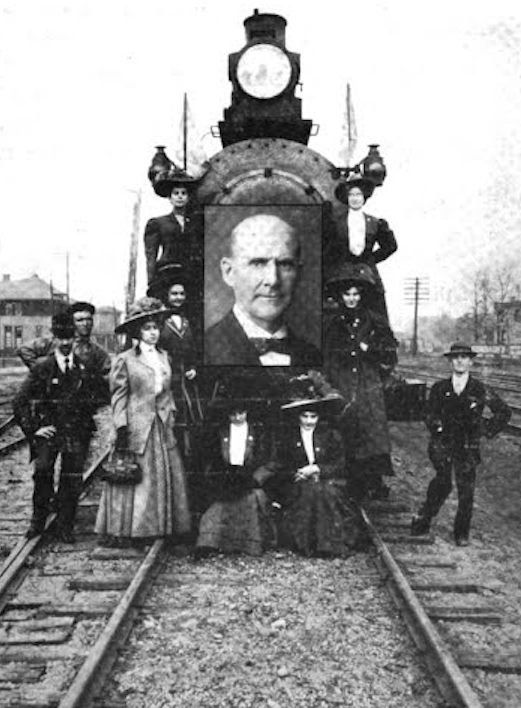
A fifth image (of Debs face on the front of the train) is published by Janet Raye at [weneverforget.org] (4 December 2018) and attributed to--
Charles Lapworth "The Journey of the Red Special as Told by Charles Lapworth" International Socialist Review Friday December 4, 1908.
--Lapworth's "Tour" and "Journey" are credited to the same issue of ISR but might not be the same article. Either way, the fifth image of the Red Special (with Debs face on the front of the train) did not appear in the archive.org "Tour" pages. Ray also has a (22 October 2018) piece about the Red Special in Montana and Buffalo.