hist_img:

democracy: Marx and Tocqueville
There were two paths towards liberalizing democracy proposed by European thinkers during the second wave of the Enlightenment revolutions (in an around 1848). Tocqueville promoted conservative republicanism. Marx promoted socialism in pursuit of communism. They both included a period of extreme democracy. Marx required a dictatorship of the proletariat and used it as a force against bourgeoisie institutions on the road to socialism. Tocqueville feared a crisis of too much democracy. He promoted voluntary organizations instead of direct political action. These organizations maintained social order during politically turbulent times.
The question of how much democracy is too much illuminates much intellectual theorizing in political economy. Actual democrats, perhaps called populists today, probably believe this question too important for the elites. A third path was also present during the Monarchist upheaval of '48--the anarchists. This bunch caucuses with the Marxists but is not trusted by them. Their disruption of liberal order upsets both step-by-step doctrinaire leftists (shop floor democracy-dictatorship of proles-socialism-communism) and the liberal milieu that is their launching pad. This liberal milieu--with all its social class stratification--also happens to be the desired status quo for republicans like Tocqueville.
It seems Anarchists want to start from more basic relationships than capital and or political economy: The Conquest of Bread and Mutual Aid, for instance. This destabilizes the left leaning political dialectic stuck on Marxist progression and liberal progressives.
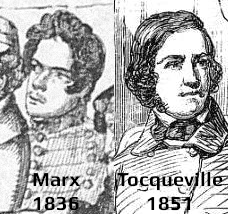
Unknown artist: Tocqueville at the 1851 "Commission de la révision de la Constitution à l'Assemblée nationale" L'illustration, journal univerel, 26 juin 1851. public doimian by date.
David Levy-Elkan "Kneipverein der Trierer Studenten an der Universität Bonn" aka "Die „Trierer“ vor dem „Weißen Roß“ in Godesberg", 1836.